How the Commercial Solar Tax Credit Works in 2026

When the federal solar tax credit for homeowners lapsed at the end of 2025, a lot of people assumed the whole incentive was gone. For businesses across the Nature Coast — Spring Hill, Brooksville, and the wider Hernando, Pasco, and Citrus County area — that's simply not the case. Commercial solar still earns a 30% federal credit, extra bonus adders, and accelerated depreciation. The catch isn't whether the money is there; it's the calendar.
There's a 2027 deadline you need to know about
Washington built two doors into the commercial credit. A project could either begin construction by July 4, 2026 or be placed in service by December 31, 2027. The first door has already closed. The second is still open, and it's the one that counts for any Nature Coast business weighing solar today — clear it and the full 30% credit, the adders, and the depreciation are all still yours.
What does "placed in service" mean? Not the signing of a contract or the delivery of pallets to your site. It's the moment the array is fully installed, inspected, and generating — usually when Duke Energy issues permission to operate. That's a real, physical finish line, and it's why a 2027 project is really a 2026 decision.
What the credit is actually worth
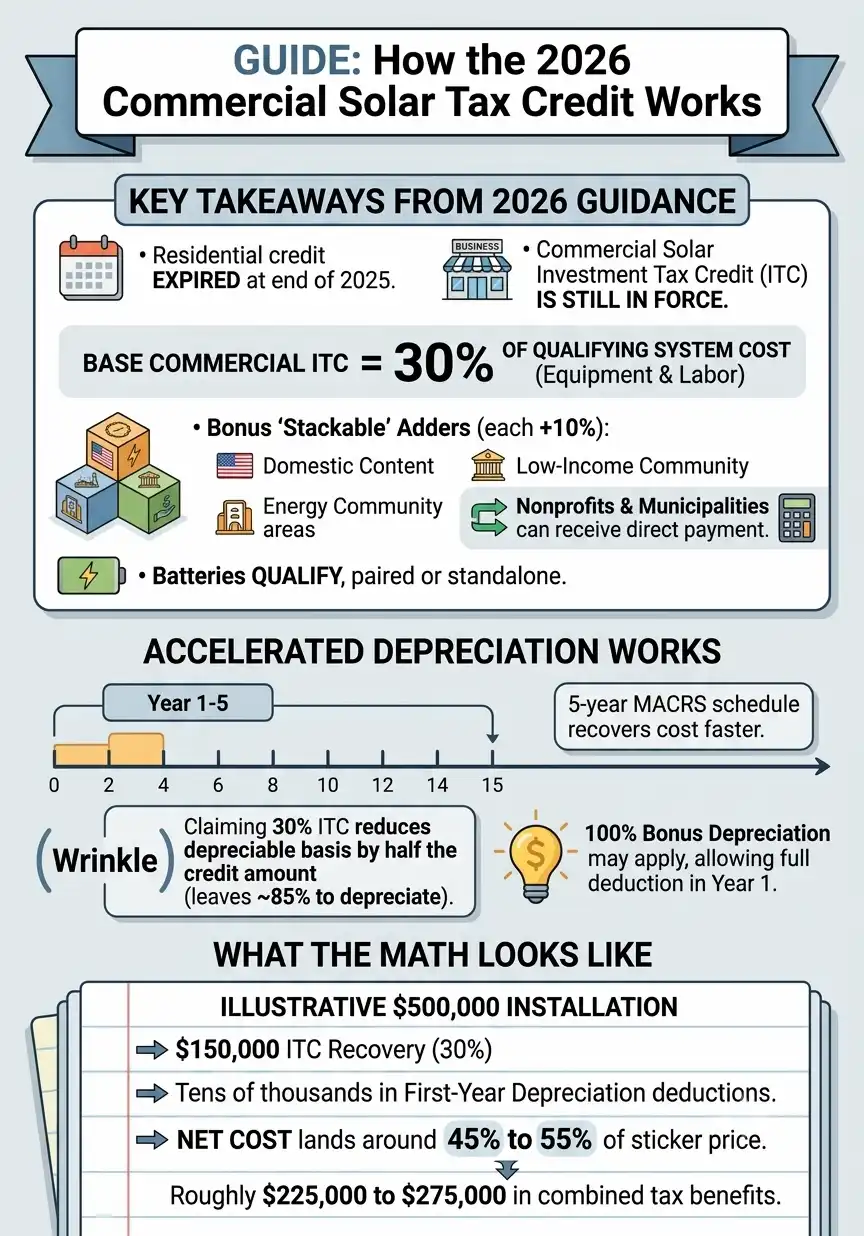
The base commercial Investment Tax Credit (ITC) is 30% of the system's cost, equipment and labor alike. On top of that sit bonus adders worth about 10% each:
- Domestic content for qualifying U.S.-made equipment,
- Energy community for designated industrial or fossil-fuel-legacy areas, and
- Low-income community for projects in qualifying areas.
Stack one or more and you're comfortably north of 30%. Batteries count as well, on their own or with panels, and nonprofits, agricultural co-ops, and municipal operations can take the credit as a direct payment rather than a tax offset.
The depreciation multiplier
Where commercial solar really separates from the residential version is depreciation. The IRS treats a solar system as five-year MACRS property, recovered on a fast, front-loaded schedule. Claiming the 30% ITC trims your depreciable basis by half the credit, so about 85% of the cost is still deductible — and 100% bonus depreciation can let you take all of it in year one instead of spreading it over six.
A working example
Model a $500,000 system:
- The ITC returns roughly $150,000.
- First-year depreciation piles tens of thousands more onto your deductions.
- Net cost after both often settles at 45% to 55% of the sticker — around $225,000 to $275,000 in combined benefits here.
Every business's tax picture is different, so use this as a model and check it with your accountant.
Why the runway is tighter than the date suggests
A commercial installation is a sequence, and a lot of it depends on outside parties:
- Structural and engineering review of your roof, land, or carport.
- Permitting with your county — Hernando, Pasco, or Citrus.
- Equipment lead times on panels, inverters, and switchgear.
- Duke Energy interconnection, whose review queue can stretch for larger arrays.
- Installation, inspection, and permission to operate.
These take weeks to months and overlap only so much. Backing them out from a December 2027 finish line lands the start squarely in 2026.
Is your operation a good fit?
Solar pays off best for businesses with strong daytime electricity use and space for an array. On the Nature Coast that often means agricultural operations, packing and cold-storage facilities, warehouses, retail plazas, and medical or office buildings. The more tax appetite you have to absorb the credit and depreciation, the better the return.
How we keep a project on the clock
Solar is an electrical project before it's anything else, and the commercial version leaves no room for guesswork on load, structure, interconnection, or code. Our contractor, May Electric Solar, designs and installs every job in-house under licensed master-electrician oversight and runs the full process — engineering, permitting, Duke interconnection, installation, and inspection. We build the timeline backward from the deadline so nothing slips.
The bottom line
The homeowner credit may be gone, but for Nature Coast businesses the commercial credit — 30%, plus adders, plus first-year depreciation — is still very much on the table through a 2027 placed-in-service deadline that's closer than it looks. Request a free commercial assessment and we'll map a timeline and after-tax numbers for your building, or start with our commercial solar page.
This article is general information, not tax, accounting, or legal advice. Federal incentives, bonus adders, and deadlines are complex and subject to change, and depreciation depends on your business's situation. Consult a qualified tax professional before making decisions based on current incentives.